
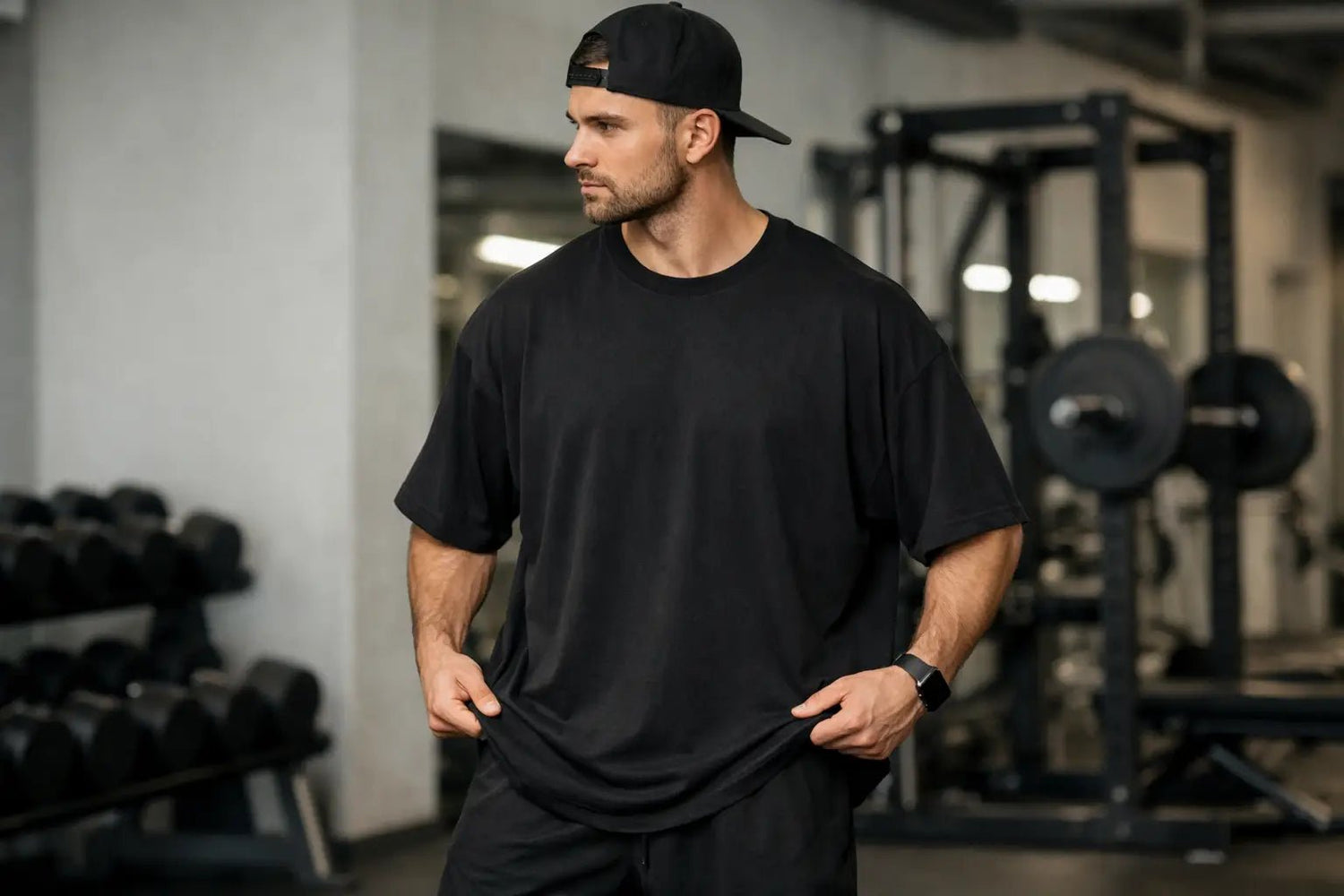
A shirt won’t do your training for you. But it can get in your way every set — or do the exact opposite.
A good oversized gym shirt doesn’t just fit loose. It gives you room on pulls, presses, and everything after the session. It brings presence without looking like a costume. That’s where a clean fit beats cheap fabric — and real gym x streetwear separates itself from forgettable mass-market gear.
Why an oversized gym shirt is more than just a wider cut
Most people hear oversized and think comfort first. Fair enough — but that’s only half of it. If you train consistently, you notice fast when a shirt is too tight through the shoulders, chest, and lats. It pulls on bench press, sticks in the heat, and after a few washes it looks like a compromise.
An oversized gym shirt moves differently. The cut gives you more freedom, especially through the upper body. In heavy upper-body sessions, that’s not a small detail. It matters. Then there’s the look: a broader silhouette, more structure, more attitude. Not polished. Not forced. Just solid.
Still, oversized isn’t automatically good. If a shirt is only made longer and wider, it usually just hangs off the body with no shape. Then it doesn’t look strong. It looks sloppy. A good piece is built with intent — room where you need it, a clean drape, and fabric that doesn’t give up straight away.
The right fit for an oversized gym shirt
The cut decides whether your shirt looks like gym streetwear or something pulled from a donation bin. A strong oversized gym shirt fits loose through the chest, shoulders, and arms without swallowing you whole. The sleeves can drop a little wider, but not so far that all arm definition disappears.
Balance matters. Too short and it turns boxy and chopped off. Too long and it kills your silhouette and takes away your shape. Especially if you train and actually carry some size, an oversized shirt needs to give you room while still holding a line.
The shoulder seam matters too. A slightly dropped shoulder gives you that classic streetwear with attitude look. But if it drops too far, the whole fit starts looking soft and weak. If you’re built broad, you usually need less extreme shaping than someone with a slimmer frame.
That also means this: there’s no one-size-fits-all oversized fit. If you’ve got a thick upper body, a clean relaxed-to-oversized cut is often enough. If you’re leaner and wearing the look on purpose, you can push it a bit more. Zero bullshit — it depends on your build.
Fabric beats hype
If the fabric can’t hold up, nothing else matters. An oversized gym shirt lives or dies on weight, feel, and durability. Light, thin cotton can feel fine at first, but it usually loses its shape fast. Sweat, washing, wear — and suddenly it looks stretched out. That kills the whole look.
Heavy fabrics sit differently on the body. They drape cleaner, feel more premium, and carry more presence. That matters even more with oversized streetwear cuts, because the shirt doesn’t just hang there lifeless. It keeps its character.
For the gym, though, the fabric can’t just be heavy. It still has to be wearable. Too stiff is just as annoying in training as too thin. The sweet spot is usually high-quality, dense cotton, ideally made in a way that won’t twist or shrink after a few washes. Organic cotton can be a strong plus here — not as a marketing excuse, but when the quality and durability are actually there.
If you train a lot, you sweat a lot. So what matters is how the shirt performs under pressure. Does it handle moisture well? Does it cling straight away? Does the collar stay stable? Those aren’t small details. They’re the things you’ll either love or hate after three weeks.
In the gym, it has to perform — not just look good
Streetwear energy is strong. But a gym shirt has to work in training first. That means enough room for clean movement, no annoying friction points, and a fit that still feels right when you’re sweating.
Take shoulder day, for example. You notice instantly whether a shirt is doing its job. If the fabric keeps blocking lateral raises or riding up your upper arm, the look means nothing. Same goes for pulling movements. A good oversized cut lets you work without constantly having to fix your shirt.
Then there’s the mental side. Yeah, sounds hard — but it’s real. If you feel solid in the mirror, you step into your set differently. A good oversized gym shirt can push exactly that feeling. Not because fabric is magic, but because attitude shows. If you live the grind, you don’t want to wear a piece that looks like fast fashion.
How to style an oversized gym shirt without looking like a show-off
The whole appeal sits right at that point where gym and street meet. The shirt should look trained, not dressed up. That’s why oversized works best when the rest stays clean.
In the gym, it hits hard with tapered joggers, heavy shorts, or clean pump cover fits. After training, you can carry the look over with cargos, loose denim, or simple caps. Less usually hits harder here. Too many loud elements turn presence into posing fast.
Color matters too. Black, off-white, grey, washed tones, or rich earth shades usually do more than over-the-top prints in ten different colors. If the cut is right and the fabric has quality, the shirt doesn’t need to put on a show.
Branding can be there, but it needs attitude. A good piece doesn’t scream. It just stands there. That’s exactly why clean designs work so well — they let the body, the shape, and the energy speak first.
Mistakes to avoid when buying
The most common mistake is simple: sizing up instead of choosing a proper oversized fit. Going one size bigger doesn’t automatically turn a regular shirt into a good oversized gym shirt. Most of the time, it just gets longer, shapeless, and worse balanced.
Mistake number two is buying blind off pictures. Product photos can look brutal, especially with good lighting, a pump, and clean styling. What matters is how the shirt actually falls in real life. Check the fabric details, the cut description, and whether the material is heavy or thin.
The third point is durability. If the seams are weak, the collar loses shape fast, or the shirt is done after a few washes, it wasn’t a good buy. Especially with premium gym streetwear, you’re not just paying for a look — you’re paying for repetition: wearing it, washing it, and styling it again and again.
And then there’s honesty. Not every oversized shirt is made for hard training. Some pieces are more lifestyle with a gym look. That’s fine — as long as you know what you’re buying it for. If you want a shirt that can go with you set after set, you need more than just a trend cut.
Who an oversized gym shirt really makes sense for
If you train regularly, care about strong fits, and don’t want thin throwaway shirts, the answer is pretty clear: it makes sense. Especially if you don’t separate your clothes into gym and everyday wear, but want both in one.
An oversized gym shirt is made for people who want substance in their look. For people who don’t walk into the gym polished, but focused. For athletes who want comfort without looking soft. And for anyone who sees clothing as part of their mindset.
It’s not the best piece for every situation, though. For pure cardio or very hot summer days, some people would rather wear something lighter or sleeveless. That’s not a contradiction. This isn’t about oversized always winning. It’s about knowing when it’s the right move.
If that mix of presence, comfort, and everyday wear is exactly what you’re after, you’ll end up with well-made heavy fits sooner or later. Brands like JAWX are built right there — clean cuts, heavy fabrics, and a look that doesn’t beg for attention.
What really matters in the end
A strong oversized gym shirt isn’t some trend costume. It’s a piece for people who show up — in the gym, on the street, and in the way they carry themselves.
If the fit is right, the fabric holds up, and the shirt doesn’t hold back your movement, you don’t need loud performance. Attitude is enough. And that can’t be faked.
